
Small grants make big difference: West Virginia Humanities Council funds disbursed in communities
Trending
Joni Morris had no idea she would stumble upon an ancient graveyard behind Bass Pro Shops on Lawless Road in Morgantown, let alone her own family's.
She said the Breakiron cemetery is about a quarter of the acre it should be, per the cemetery deed, and there's a sediment pond within 60 feet of the burial grounds. As a third-generation family historian, Morris was outraged.
"I found out about this, and it kind of lit a fire under me because I didn't want something like this to happen to somebody else's family cemetery," she said.
Morris is now the contractor for cemetery conservation work and preservation under the Preservation Alliance of West Virginia (PAWV). In this role, she hosts educational seminars for communities statewide and nationally on gravesite repairs, protection and documentation.
"I use the 'Find a Grave' and 'BillionGraves' apps, and I kind of learned that there was no real instruction on how to use those apps to document the cemeteries," she said. "When I was in AmeriCorps with PAWV, I developed a course to teach people to use those apps, and we did a pilot. I had always done some preservation work on my own physical stone clearing and resetting. (In) Americorps, I got more training on the physical end of things, and so I combined that into a workshop, showing people how to document the cemeteries, and also how to physically preserve the stones and do repairs."
Despite leaving the Americorps league, Morris said these workshops are possible today due to the West Virginia Humanities Council annual grants.
The WVHC, the state affiliate of the National Endowment for the Humanities, provides direct funding for nonprofit organizations throughout the state. During this donation period, 27 "mini grants" of $2,000 or less were distributed across West Virginian groups and projects, including Morris' West Virginia Cemetery Documentation & Preservation Project.
"I wanted to be able to continue these workshops, and the grant from the Humanities Council is giving us the opportunity to do that, to continue to provide these to people so that they can learn how to upkeep and preserve their family or their local cemeteries."
Morris stressed the importance of proper cemetery documentation through the West Virginia State Historic Preservation Office, which protects gravesites that may be future building zones for federal offices, gas lines or development companies. She hopes her efforts will help the greater public see the gravesites as a cultural resource.
"There is becoming more of an awareness in the state of our heritage and our Appalachian culture, and these small family cemeteries that seem to be on every mountaintop, people are becoming more aware of them and are getting more and more interested in preserving them," she said. "I applaud the Humanities Council for continuing to support this effort and continuing to support preserving this small portion of not only our community heritage, but also our history."
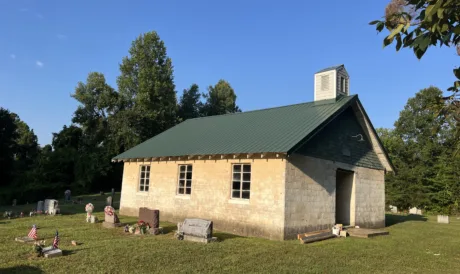
Dr. Candice Coleman-Pope's nonprofit, Potts Chapel Restoration, also received a grant from the Council. Coleman-Pope is a current resident of Florida, but finds her roots in Mason County and the Potts Chapel Church in Apple Grove.
"Potts Chapel is walking distance to my grandparents' property, now my parents' property, so I've gone there since I was a little girl," she said. "It was in service many, many years ago, but it's still this beautiful, abandoned chapel that someone has lovingly maintained for years and years."
This year on a summer visit, Coleman-Pope entered the church grounds to find it completely desecrated, spray painting of "demonic" drawings on its walls. Coleman launched her own investigation to find the perpetrator, the mystery maintainer and raise community support to restore the church to its former glory.
While Coleman-Pope never discovered the vandal, she was able to find the last living family member of a trust who was using her own money for the chapel's upkeep. Following the woman's death last month, the church was left in the hands of Coleman-Pope and the people of Apple Grove.
"The whole thing has just been a wild, unbelievable story that I have to believe was divinely orchestrated," she said. "I was able to connect with her family, create a nonprofit and write a little workbook about restoring our physical body, similar to the chapel because to me, our body is the body that we've been instilled to steward."
The WV Humanities Council grant allows Coleman-Pope and volunteers to clean the church, maintain its grounds and hold informal worship services. She said there will be a Heritage Day on Friday, when community members will collaborate on a documentary and revival of the church's history.
"For me, it has a unique emotional context because I've grown up there, but also the history of the families, there is a cemetery there. For me, it's kind of a mirror of just taking care of something that is sacred. It is a sanctuary space, so I do believe that it should be preserved and cared for, and so should history."
Trey Kay of the West Virginia Public Broadcasting Foundation credits his career to the Humanities Council.
He said he first came to the council in 2008 with a documentary pitch on the Kanawha Textbook Controversy of 1974, which later went on to win the Peabody Award, Edward R. Murrow Award and the Columbia Dupont Award.
"I'd never written a grant for a project like that documentary, and I had people at the Humanities Council who were very encouraging and went out of their way to help me, even though I didn't know what I was doing," Kay said.
Kay's most recent award helps sponsor his podcast, "Us & Them: Across the Table Before the 2026 Midterm Election," which brings together West Virginians across political parties to discuss some of the most polarizing topics today.
Kay said, that despite federal funding cuts from the Trump administration, he is glad to have received continued support from the Humanities Council for the last 20 years of his career.
"They have been incredibly supportive of my work," he said. "When you go out in life, and you're trying to accomplish something, and you have that first group, that first organization that helps you...They've just been a fabulous organization, and it's a shame that they've been as hobbled as they are."
Kay hopes to continue raising awareness on government issues, as well as engage communication with humanities scholars, in years to come.
Read more about the WV Humanities Council Grants at https://wvhumanities.org/grants/aboutourgrants/.