
Tourism Department left dealing with W.Va. arts agency’s fiscal issues after merger
Trending
CHARLESTON – Legislative auditors found numerous fiscal and administrative failures in the former West Virginia Department of Arts, Culture and History, issues that are now the responsibility of the Department of Tourism.
The Post Audit Division of the Legislative Auditor’s Office released a report earlier this week on the state Department of Arts, Culture and History, which was absorbed by the Department of Tourism in 2025 at the request of Gov. Patrick Morrisey.
Speaking to members of the Legislature’s Post-Audits Subcommittee on Monday, Audit Manager Adam Fridley said their review of ACH came ahead of the department’s divisions and commissions being absorbed by Tourism effective July 1, 2025, after the passage of House Bill 2009 during the 2025 legislative session. Morrisey made combining ACH and Tourism a priority upon taking office at the beginning of 2025.
"Subsequent to passage of that bill and in the lead up to its effective date, former Secretary Chelsea Ruby and her team approached the legislative auditor and asked for our assistance as the secretary and her team prepared to fully incorporate" Arts, Culture and History, Fridley said. "They were beginning to note a number of issues."
According to the audit report, those concerns included division-level fiscal management, cash handling and inventories of assets. Auditors confirmed that many of these issues existed.
"It’s a real testament to the Legislature and to the governor’s leadership on merging (that department) with the Department of Tourism, because after the merger, during the transition, as Krysten (Wolfe), our CFO and her team started to really try to get a handle on what was happening within (Arts, Culture and History), that’s when they started to recognize that there were some things that were off and then immediately reported to the legislative auditors and have been working with them since then to get things in order," said Department of Tourism Secretary Kayla Kessinger, who succeeded Ruby in August.
Auditors discovered that specific ACH accounts were over-encumbered, creating millions of dollars in shortfalls for the former department. Two specific special revenue accounts - a cash collection account for fees, rentals and gifts; and an account used for capital improvement grants and preservation - were over-encumbered by between $1.5 million and $2 million. These shortfalls caused the Legislature to appropriate additional money to ACH.
Interviews by auditors with ACH staff found that prior to its combination with the Department of Tourism, ACH divisions were decentralized, managing their own budgets and expenditures with next to no input by former cabinet Secretary Randall Reid-Smith and ACH central administration, which served more as a "final receiver of financial and procurement documents."
When duties were handed off to Tourism officials, they discovered that many grants and contracts were not entered into wvOASIS, the state’s software system that manages finances and purchasing, in a timely manner, causing billing issues.
"Failure to enter financial obligations such as grants and contracts into the system timely, or at all, can result in divisions believing they have more money to spend than they do," auditors wrote. "Tourism indicated that in some instances, it was only aware of a financial obligation when the vendor requested payment against an existing grant or contract."
After providing auditors with a list of all active grants and contracts, more than 50 open encumbrances were discovered with almost no documentation. While some represented old accounts that hadn’t been closed out, Tourism officials were concerned there were some obligations for which ACH had not been billed yet.
Auditors also found 72 ACH grants not provided in the initial listing, with a combined dollar amount of more than $900,000. Auditors praised the new management by Tourism for putting in place best budgeting and fiscal management practices.
"In addition, the Department has worked to ensure all financial obligations are accounted for appropriately and timely to ensure divisional spending levels stay within appropriations," the auditors wrote. "The Legislative Auditor recommends that the Department of Tourism continue to ensure all financial obligations are accounted for timely and appropriately."
According to the report, ACH lacked policies for handling cash and did not follow existing state code for the handling of cash receipts at locations including the Culture Center, Camp Washington Carver, Grave Creek Mound, Independence Hall, the Coal Heritage Museum and Volunteer West Virginia.
Also, Arts, Culture and History did not collect and remit sales taxes for a 10-year period. After self-reporting the issue to the State Tax Department, a settlement was agreed to that covers a four-year period, with the Department of Tourism paying a total of $122,025.
"The Department of Tourism indicated to the Legislative Auditor that Arts, Culture and History had not appropriately collected and/or remitted sales tax collections since approximately 2015,” auditors wrote.
"The way I uncovered it was by looking through their cash accounts," Tourism CFO Wolfe told subcommittee members. "I noticed ... they were marking that there was sales tax, but they were not separating it into the different accounts. So, they were putting it all into the cash account. That cash account was one of the accounts that we recognized was over-encumbered. It was paying salaries. It was buying expenses. It was going to operations. It was spent on multiple things."
"All of this sort of boggles my mind," said House Majority Whip Marty Gearheart, R-Mercer. "I file sales tax returns as do some others here. I can tell you if I’m a week late with my sales tax return, I get a notice. If I were a year late, I’d have a stack of notices. ... It is beyond me to understand how 10 years of sales tax could be neglected. There would have to be a room full of notices that could fill a closet."
"”There were and there weren’t," Wolfe said. "There were in some instances, but some places hadn’t reported sales tax in 10 years and (the State Tax Department) had quit sending notices because they thought (Arts, Culture and History) wasn’t collecting any income.”
Senate Government Organization Committee Chairman Robbie Morris, R-Randolph, asked what ACH did with the money it was supposed to remit in sales tax.
"I’m assuming because we were on a payment plan ... we have no idea what happened to the sales tax money," Morris said. "Was it sitting in a different fund and just wasn’t paid back? Or was it put in the general operating account then expended?"
"If it was collected, best guess was it probably was just appropriated for general use," Fridley said. "It certainly didn’t go to taxes as it should have."
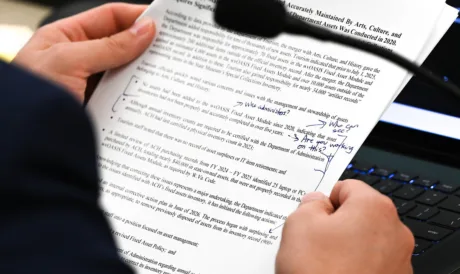
Finally, auditors found that ACH had not conducted an asset inventory since 2020, including historical assets and special museum collections. No new assets had been entered into wvOASIS since 2020, and annual inventory counts required by the Department of Administration were not done since 2023. The State Museum did not have updated policies and procedures governing the maintenance and inventory of its special collections assets.
"The Department of Tourism acknowledged that this is an area that requires significant improvements," the auditors wrote. "The Department has added additional staff to focus on collection management and stewardship. In addition, it has begun the process of updating its collections policy, which includes having the new policy reviewed and approved by the History and Archives Commission."
Del. Kayla Young, D-Kanawha, raised concerns that the issues at ACH only came about because the Department of Tourism asked for an audit versus being proactively found by various state agencies over the years, such as the State Tax Department, the Department of Administration and the State Treasurer’s and Auditor’s Offices.
"I guess we don’t know if there are backstops with the auditor or the treasurer that can kind of capture these things," Young said. "This is the result of a merger of departments, which is highly unusual. Other than that, this could be going on who knows where and we would have no clue essentially."