
Observing the autumnal equinox
Trending
Fall begins on the autumnal equinox. Although people may see it as the official kickoff to bonfires and flannels, that’s not the only interesting part of this remarkable day.
— It’s a moment and not a day. Despite what many people think, the autumnal equinox is not an entire day. In fact, the equinox is a precise astronomical event. It occurs at the exact moment the sun crosses the celestial equator, an imaginary line in the sky directly above the Earth’s equator.
— It’s not “equal night.” Although the word equinox comes from the Latin word “aequus” (equal) and “nox” (night), we do not get exactly 12 hours of daylight and 12 hours of darkness on the equinox. This is because of how the Earth’s atmosphere refracts sunlight. The sun appears above the horizon even after it has technically set, according to the National Weather Service.
— Northern lights can be seen. Those hoping to catch a glimpse of the aurora borealis will find the weeks surrounding the autumnal equinox are the prime window to do so, according to NASA. Geomagnetic storms that trigger these stunning light displays occur twice as frequently around the fall and spring equinoxes compared to the summer and winter solstices.
— It’s not always on the same day. The autumnal equinox does not fall on the same day each year. It usually lands on Sept. 22 or 23, but it can occasionally occur on Sept. 21 or 24 (in the northern hemisphere), indicates the U.S. Naval Observatory.
The autumnal equinox is a unique and often enjoyable day on the calendar.
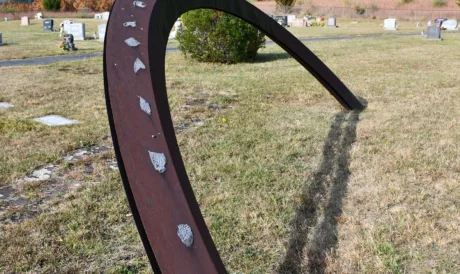
In a quiet hillside cemetery in Maysville, West Virginia (about 10 miles north of Petersburg), a strange fixture greets visitors. The Muntzing Equinox Arch was designed to allow sunlight to pass through a narrow slit only on the Spring and Fall Equinox each year. Every other day, the shadow is a solid line about 6 inches wide. On the Spring and Fall Equinox, there is a sliver of sunlight that passes through the arch and divides the shadow.
This twice-a-year phenomenon will happen Tuesday, Sept. 22, weather permitting. Everyone is hoping for a sunny day. The light passes through all day, but is best when viewed mid-day or afternoon.
The plaque reads:
This arch is designed to permit light from the sun to pass through the arch on the equinoxes during March and September when the sun is directly over the equator. It is the time of equal days and nights. It symbolizes the connection between Heaven and Earth.
Life and death are spiritual gifts from God to be treasured by the living and remembered for the dead. The arch provides hope for those who see it and a memory of those who rest here. The first Muntzings came to the United States in the 1830s, and with their descendants are buried in this cemetery and elsewhere in Grant County. Their pioneering spirit is an inspiration for future generations.
Directions to Maysville: From Morgantown, it is about 100 miles to Maysville. Take I-68 East to Friendsville MD, then south to Oakland MD. From there, go to Mount Storm, WV, and head south on Route 42. Follow Route 42 south to the town of Maysville. Watch for a small sign on the right. Take a sharp right turn and follow the narrow lane about 300 yards up the hill to the Maysville Cemetery. The arch is on the upper side of the cemetery.
MetroCreative contributed to this report.