
Lawmakers seek compromise on Raylee’s Law
Trending
CHARLESTON - A group of lawmakers are trying to avoid the drama of the last night of the Legislature and find agreement on a draft bill meant to protect students from being pulled out of public school while under child welfare reviews, but homeschool advocates remain opposed and some lawmakers question the bill's effectiveness.
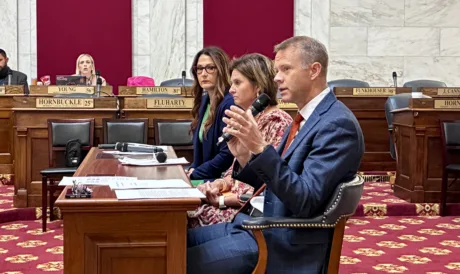
Members of the Joint Committee on Children and Families were briefed Monday during September legislative interim meetings at the Capitol about a proposed bill based on Raylee's Law that will be introduced in January during the 2027 legislative session.
The bill would require school officials to notify a principal of any student transfer or withdrawal from a public school by the next business day. The principal would be required to Child Protective Services if a child is withdrawn/transferred and has been the subject of a substantiated abuse or neglect report within the previous 12 months.
Once notified, CPS must treat these notifications as allegations of “imminent danger,” responding immediately with a face-to-face interview with the child or family within 72 hours. The bill also establishes chronic absenteeism as a circumstance requiring notification to CPS upon student withdrawal.
The draft is the latest version of Raylee's Law, named for Raylee Jolynn Browning, a child in Oak Hill who died in 2018 due to abuse by her father, Marty Browning. According to press reports, Raylee had been pulled from public school by her father, who was sentenced, along with his girlfriend and girlfriend's sister, in 2022 after being convicted of child neglect causing death.
A version of Raylee's Law has either been introduced or amended into other bills every year since 2020 and supported by a bipartisan group of lawmakers. House Bill 5537, a bill repealing obsolete and outdated sections of the education code, became the vehicle for Raylee's Law in the last two days of the 60-day annual legislative session earlier this year.
But supporters of homeschool community and educational choice in the House of Delegates filibustered HB 5537 in the final hours of the session on March 14, causing the bill to die before the Senate could take up the bill by the midnight deadline. Over the summer, a small group of lawmakers began working on a version of Raylee's Law that could please both supporters of the bill and homeschool advocates.
Kim Legg, the attendance director for Kanawha County Schools and a social worker, said she supported the draft and was confident that county school systems could handle the additional administrative requirements.
"I think this is a wonderful piece of legislation," Legg said. "We do see a lot of (homeschool) students whose families do an amazing job ... But we also have students, when schools do contact Child Protective Services, they go to homeschool. If we do pursue truancy, they go to homeschool."
According to Legg, Kanawha County Schools has already processed 123 new notices of intent to homeschool since the beginning of the current school year in August, with 48 of those notices coming from parents and guardians whose children are considered chronically absent. According to data released earlier this year by the state Department of Education, 71% of students pulled from public schools for homeschooling were considered chronically absent over a three-year period.
Kendra Boley-Rogers, the deputy commissioner of the West Virginia Bureau for Social Services, said she supported the overall intent of the draft bill, but she also said that it would put more operational pressures on CPS workers who are already understaffed and overloaded with cases.
"I would like to say that the bureau absolutely supports the goal of protecting children. That’s what we do every day," Boley-Rogers said. "It is about, obviously, resources (and) ensuring that we’re protecting the children that really need our assistance and making sure that those kids are getting the protection and safety in place and the families are receiving the services."
"Striking that balance, I think, is really critical to ensure that we’re not showing up on someone’s doorstep as an imminent danger response when it’s not warranted based on not really having all the information in the beginning," Boley-Rogers continued.
Under questioning by Del. Kayla Young, D-Kanawha, both Legg and Boley-Rogers said that mandatory reporters, those legally required to report suspected child abuse, including teachers and school administrators, might receive a letter informing them that CPS initiated an investigation based on their report, on those who filed the report receive those letters, not the principal.
"Do (principals) have access? If anyone else makes a report, any other mandatory report or anyone at all, the principals aren’t going to have that information," Young said. "Even if we pass this bill, we would have to also change the law to make it so principals would have access to all of that information ... This wouldn’t protect with a pending allegation. This would have to be a substantiated allegation."
Kevin M. Boden, director of legal and legislative advocacy for the Home School Legal Defense Association, testified against the draft version of Raylee's Law, arguing that it inappropriately links educational choices with child abuse suspicion.
"There’s no reason, in our opinion, that there would be any involvement with social services or any other agency other than the education officials on where that child is going to be educated," Boden said. "After all, when they transfer from public school or private school or a micro school or a learning pod, they’re simply transferring their educational decision for their child to a different modality. The choice of modality of education has no need to involve other services, in particular Child Protective Services or any other agency outside of the educational sector."
Grady, an elementary school teacher in Mason County who was one of 15 senators who supported the Raylee's Law amendment to HB 5537 earlier this year, said the effort for another Raylee's Law bill had nothing to do with those who homeschool their children.
"We’re not looking at just homeschool situations, but also children being withdrawn from their school where people have eyes on them and being taken out of state or taken somewhere else," Grady said. "I’m a firm believer in a parent’s right to choose the education for their child ... But I want us to find some balance."
CPS currently screens approximately 42% of referrals. Imminent danger referrals currently require 72-hour contact. The bill would bypass the screening process, automatically investigating any withdrawal that meets the 12-month/absenteeism criteria. While Boley-Rogers said CPS workers absolutely investigate imminent danger reports, Legg said sometimes it takes additional reports to CPS.
"Sometimes I feel like some of them are handled quickly and then sometimes I think things get screened out and ... we just make another report," Legg said. "But for the most part, I feel like we do have a good relationship with our CPS workers in Kanawha County, and they collaborate with us to help children."