
W.Va. officials order flat budgets for FY28 despite outperforming revenue estimates
Trending
CHARLESTON - Two months into the new fiscal year, West Virginia is showing a modest tax revenue surplus, but the state's finances did not trigger a new personal income tax cut and state departments and agencies have been told to maintain flat budgets for the next fiscal year.
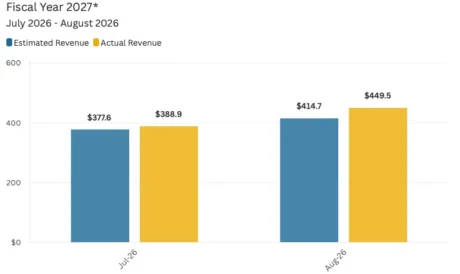
According to data released Tuesday by the Senate Finance Committee and the state Department of Revenue, West Virginia has collected $838.3 million in taxes for the general revenue budget for the first two months of fiscal year 2027 which began in July.
As of the end of August, the state has received $46.1 million in surplus tax collections, 5.8% more than the $792.3 million estimate from the Department of Revenue and 6.8% more than what was collected in the first two months of fiscal year 2026.
"West Virginia continues to outperform expectations," Gov. Patrick Morrisey said in a statement Tuesday. "We are proving that we can deliver meaningful tax relief while keeping our state on strong financial footing. We will continue to hold the line on spending, grow our economy, and look for every opportunity to put more money back in the pockets of West Virginians."
The budget for fiscal year 2026, which concluded on June 30, ended with $5.7 billion in total revenue, exceeding estimates by $370.6 million, or 7%. This represents a 3.2% increase over the prior fiscal year, trailing slightly behind the 3.5% inflation rate.
Of the $370.6 million surplus, $245.35 million has already been approved for appropriation through the surplus section in the back of the FY27 general revenue budget, leaving approximately $147.9 million in unappropriated general revenue surplus from the previous fiscal year.
Despite good performance in tax collections, Department of Revenue Secretary Eric Nelson told members of the Joint Standing Committee on Finance last month that the state will once again not meet the conditions for triggering a future cut in personal income tax rates.
"It will not be hit this year," Nelson said during legislative interim meetings in August. "We were significantly below, so an automatic trigger for fiscal year '28 will not occur, and leadership has been informed of that."
A tax reform package, passed in 2023 and amended in 2024, included a trigger mechanism for future personal income tax cuts. The last time the state met the trigger was 2024, with a 4% personal cut going into effect in calendar year 2025.
To determine whether there will be additional personal income tax cuts, the Department of Revenue compares general revenue collections in a previous fiscal year minus severance tax collections to the base year of fiscal year 2019 and tied to the non-seasonally adjusted consumer price index.
If the department determines that the trigger is met, a personal income tax cut goes into effect one year after the next calendar year, limited to up to a 10% cut, though originally the tax cut would go into effect the very next calendar year.
Lawmakers cut personal income tax rates by 21.25% for calendar year 2023 at the urging of then-Gov. and now U.S. Sen. Jim Justice, with the Legislature passing another 2% cut for calendar year 2024 on top of the 4% personal income tax cut trigger. In 2026, the Legislature passed a 5% personal income tax cut at the request of Morrisey.
With every 1% cut to personal income tax rates equal to approximately $25 million, more than $800 million has been returned to taxpayers since 2023. Personal income tax collections roughly make up 40% of all general revenue fund collections and the largest percentage of tax collections.
The Department of Revenue has turned its attention to crafting the FY28 general revenue budget bill, which Morrisey will present to lawmakers in January when the new 60-day regular session of the West Virginia Legislature begins. According to the Appropriation Request Instructions report issued by the Department of Revenue for FY28, state departments and agencies are being urged to keep their budget requests flat.
"As we begin the FY28 budget process, our goal is to maintain fiscal discipline by controlling spending and ensuring that programs remain financially sustainable," Nelson wrote to cabinet secretaries and agency heads on July 31. "General Revenue FY28 budget requests should remain at or below approved FY27 funding levels.
"Agencies are required to conduct a thorough review of existing programs to identify opportunities to right-size operations, improve efficiencies, or eliminate programs that are no longer necessary," Nelson continued. "Base budget increase requests will be considered only for emergency or critical needs."
Departments and agencies had until the end of the day Tuesday to submit their budget requests to the Department of Revenue, with departmental budget hearings planned to take place between September and October.