
Fairmont toddler to be featured in NYC Down syndrome awareness
Trending
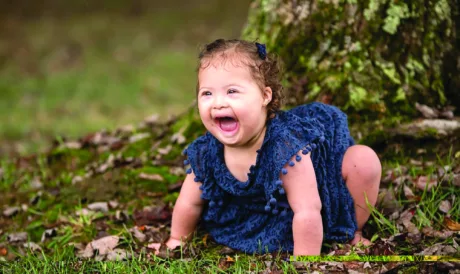
FAIRMONT - It was one of those light-infused, late afternoons - what photographers call "The Golden Hour" - when Isabella Wolford was just being, well, Isabella.
Unbridled joy, and all.
Her dad, Justin Wolford, picks up the tale.
"She was just learning how to crawl," he said.
"She's rocking back and forth and we're all going, 'Yay, Isabella,' and all the things you do. She gets this giant smile, then it's 'Get that picture. Get that picture. Nobody move.'"
What ensued was golden.
Two weeks from now in Times Square, New York City, photographic evidence of that moment and that afternoon is going on the Jumbotron for all the world to see.
Isabella's picture will be featured Sept. 12 during the annual awareness event by the National Down Syndrome Society.
The society takes an afternoon every year in the metropolis to showcase people surviving and thriving with the chromosomal condition that can hamper cognitive and physical development.
For Justin and Pamela Wolford, "awareness," is the watchword concerning their life and times with their toddler, who is now two-and-a-half.
They're parents to older children, also.
During the 10th week of the pregnancy, Pamela had undergone genetic testing to determine whether Isabella was going to be a boy or girl.
Other markers in the testing revealed a more than 90% likelihood of Down syndrome, Justin remembered.
"It was presented to us as this tragic news," he said.
"And I'll be honest: There was a little bit of grieving going on at first, if that's the right word," he continued. "You do mourn what you thought had been a perfect pregnancy up to that point."
After the reeling, though, resolve took over.
"We said, 'This Isabella. This is our baby girl,'" Justin recounted.
"We were gonna get her here and we were gonna love her, and that was it. And I really think she sees the world closer to the way God sees the world. We were blessed and just didn't know it."
Along the way, they connected with other Down syndrome families.
They became advocates. The Down Syndrome Network of West Virginia turned into an oasis. So did the outreach through the state-funded West Virginia Birth to Three program.
Just like the golden hour of that afternoon when a kid was learning to crawl, they became cheerleaders for the cause.
The annual call for photographs from the National Down Syndrome Society was part of it, Justin said.
He entered, for fun and with serious intent, at the same time.
A couple of days later, he heard back. Isabella made the cut, selected from nearly 3,000 entries.
Her snap will be incorporated into a one-hour live-streamed video featuring toddlers, teens and others with Down Syndrome, and hailing from across the U.S. and 12 countries on that September Saturday.
Visit the society's Facebook page for full details.
It wasn't that many generations back, Justin said, when those born with Down syndrome were institutionalized.
Or sequestered away in upstairs bedrooms.
In contrast, Isabella is fully integrated into the Wolford household, her dad said.
She has an ever-expanding vocabulary. She's adored by her older siblings.
Normalcy, well, is the norm, he said.
That means praising, or reprimanding, he said - depending upon what the circumstances dictate.
"Down syndrome kids grow up and live on their own," he said. "They hold jobs. They get married."
And, they become critically acclaimed photographers, too.
Rachel Handlin, who was born with Down syndrome, graduated in 2024 from Pratt Institute in Brooklyn with a Master of Fine Arts in that field.
She knows all about the golden hour and the art of using the viewfinder as a canvas.
With the ink barely dry on her diploma, Rachel began celebrating through her lens 23 other adults in the world with Down syndrome who also earned two-year and four-year degrees from colleges and universities - in mortarboard defiance of ingrained perception.
"I want to open the door for kids with Down syndrome to get an education like me," she told a Voice of America reporter.
"A lot of people don't think we're smart. Some people won't talk to me. They ask my mother what my name is, how old I am. They don't ask me. My mother gets mad. It makes me feel invisible."
The Times Square Jumbotron, Isabella's dad said, is a pretty good start to not being that way.
"People with Down syndrome want to be included. They want to be seen."