
From Oceana to Venice: WVU alum Lester shows sculptures in Italian exhibition
Trending
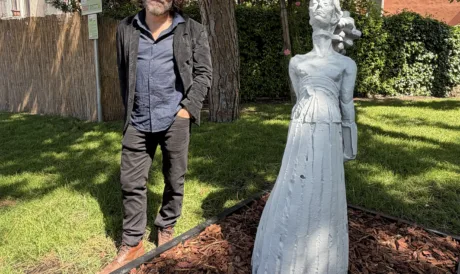
WVU alumnus Jamie Lester has two sculptures on display at the Giardini Marinaressa in Venice, Italy, as part of the eighth iteration of the European Cultural Centre Italy's exhibition "Personal Structures," which runs through Nov. 22.
A West Virginia native, Lester double-majored in Sculpture and Ceramics at WVU and earned his Bachelor of Fine Arts degree in 1997. He gained widespread recognition for his bas-relief design of the New River Gorge that graced the West Virginia quarter in 2005. That opportunity was the springboard that led him to create the bronze statues of Jerry West and "Hot Rod" Hundley at the Hope Gas Coliseum and of Don Knotts in front of the Metropolitan Theatre in Downtown Morgantown, among many others.
Lester's "Aphrodite" and "Zeus" sculptures are among works from 150 artists featured in "Personal Structures," which runs alongside the famous Venice Biennale. ECC Italy's exhibition sprawls across the Marinaressa Gardens, the Palazzo Bembo and the Palazzo Mora.
"It is an absolutely huge show, and it is such an honor to be a part of it," said Lester. "It has totally changed my perception of what's possible."
The original versions "Aphrodite" and "Zeus" were created in 2025 as part of Lester's "Way of the Gods" series of ceramic and steel figures inspired by Greek gods and mythological figures. For these, rather than casting solid bronze similar to his well-known Morgantown statues, Lester blended traditional clay sculpting with clay coiling methods and steel welding techniques he learned at WVU under then-coordinator of Sculpture Alison Helm.
Certain sections of the figures, like the torsos, were created by vertically layering rows, or "coils," of clay to create a hollow structure. Other parts were modeled, plaster-casted and then lined with ceramic clay or created with strips of steel welded together.
However, for a show in Italy--the birthplace of masters like Da Vinci and Bernini--Lester wanted to show something that echoed the history of figures carved in stone and embraced the tradition of public sculptures.
Plus, the original "Aphrodite" and "Zeus" had been sold to private buyers when the series was part of an exhibition in Alexandria, Virginia.
Fortunately, Lester had integrated 3D scanning, modeling and sculpting with programs like ZBrush into his workflow over the last decade, so he used scans of "Aphrodite" and "Zeus" to create new molds for bronze casts.
Because of the delicate lines, thin shapes and hollow spaces created by the steel bands in the original sculptures, Lester had to make modifications to "Aphrodite" and "Zeus" before they could be translated into solid bronze pieces.
"With 'Aphrodite,' I did a little bit to her to make her 3D printable. The hands were basically steel cut flat, like a paper doll, then bent into shapes. They're only the thickness of a piece of steel, not really castable in bronze, so I had to go back in ZBrush and sculpt actual hands," said Lester.
He had to do the same with her hair, turning it from ribbons of steel into a solid mass that could be printed and casted.
"'Zeus' was only half of a piece that was meant to be displayed up against a wall. So in ZBrush, I sculpted the back of the head to make it fully round instead of a deep relief and finished the buildings on the top. It’s a totally different piece," he continued. "They’re not just 3D scans of the original pieces. They're like new sculptures that were digitally modeled from 3D scans of the 'Way of the Gods.'"
Finally, Lester had a white patina of titanium dioxide added to the bronze castings to evoke classical white stone statues.
"Titanium dioxide is known to oxidize outdoors, so they'll probably turn black and green in unpredictable ways," said Lester. "I think they're going to be even better once they begin to oxidize."
Lester hopes to be invited back to ECC Italy's "Personal Structures" exhibit, though he hopes to show at the Palazzo Mora or the Palazzo Bembo.
"The outdoor shows were cool, but you didn't meet as many artists, because they're outdoor pieces and people didn’t hang out in the garden all day," said Lester. "But in the indoor shows, the artists would stick around all day and talk about their work and meet people coming through the shows. It was really impressive."
Being in the birthplace of Renaissance fine art made Lester reflect on his own artistic path and the roads not taken.
Lester comes from a long line--10 generations--of coal miners, but his parents were supportive of his drawing and painting. His mother was also an artist and occasionally sold her paintings.
"My mom thought I would be a starving artist, but from the time I was little, she was giving me art supplies and how-to books. My dad supported me, but he never really thought of me as 'working,' because he was a coal miner, a laborer, all his life. Then I won the West Virginia quarter contest and suddenly he was my biggest fan," Lester recalled.
Lester received a variety of local recognitions for his artwork as a child and teenager, including having his pieces hung throughout the school and an unspoken agreement among his teachers to let him draw during class.
"When I was 18 or 19, I should have gone to an arts school that focused on the kinds of art I was interested in, but that just wasn't in the cards for me then. But, I was lucky to go to WVU and study art. Otherwise, I probably would have been another coal miner."
When he first came to WVU, Lester planned to pursue painting and other two-dimensional art, but then he discovered the wonders of 3D art, finding inspiration in the work of the Chinese visiting artist Jiansheng "Jackson" Li.
"I didn't really know what to do when I got to WVU, because I felt like I had already mastered 2D art--which is not at all the case--but then I took ceramics the second semester of my freshman year and just stayed in ceramics from that point on," said Lester.
"I started taking sculpture classes to learn to weld and carve wood. It felt like a real challenge that I could sink my teeth into," he continued. "It gave me direction and focus, because I was learning how to do something new."
Lester got that same feeling when he visited Florence over the summer. He did a two-week workshop at the Florence Academy of Art focusing on figure sculpting, and he found himself surrounded by people from all over the world and American ex-pats who had been living in Italy for decades.
"We were all there because we love figurative sculpture, classical art and Renaissance art. I just felt like that was my place," Lester said. "If I look back on my career over the last five years or so, I was getting complacent and feeling like I was better than I was. This trip to Florence has really made me see that I still have a lot of work to do."
The modern and post-modern art movements had shifted away from traditional and representational work, but Lester had always been drawn to the realistic figures sculpted in ancient Greece and Rome and during the Renaissance.
"That's the kind of work that I've always loved and always been drawn toward. At different times in my life, I felt like I had to hide it, or reject it to be valid or to be relevant," Lester said. "You're starting to see ceramic and wood artists using the figure again, and studying in Florence made me feel like there's nothing wrong with sculpting the figure. It's like the experience gave me permission to do what I love."
Lester and his family will be going back to Florence this fall as he enrolls in the three-year sculpture program at the Florence Academy of Art. He had always intended to pursue more education after graduating from WVU, but life had other plans for him, and he started a family and his business, Lester Sculpture--and later Vandalia Bronze--instead.
One of his roads not taken had circled back around and presented him with an opportunity to try a path he had long wondered about.
"I'm going to go back to school, which is kind of crazy at age 51," said Lester. "But it's actually just the right time. I have so much to learn."
Lester knows he and his family will be back stateside for visits and for work. He has current projects to finish, like a statue of David Crockett at the Tennessee State Capitol, and an application to create a monument to Ruth Bader Ginsburg in Brooklyn.
"We have this amazing opportunity to live in Italy while I study in Florence. We only have one life to live, and I don't want my epitaph to read 'He spent all his life in West Virginia and never lived anywhere else,'" he commented. "We love Morgantown, and we love our home and the studio that we have here. We have so many friends here. So, Morgantown will always be home."