
FAITH & COMMUNITY: Many ways to say ‘I love you’; Teaching children generosity as gratitude, faith and love in action
Trending
I grew up watching “Mister Rogers' Neighborhood,” and later had the privilege of knowing Fred Rogers as a colleague. We were both ordained ministers of Word and Sacrament in the Presbyterian Church (U.S.A.) and graduates of Pittsburgh Theological Seminary. Fred had a rare gift for noticing the holy in ordinary moments.
In his book “The Giving Box,” he describes a child stretching out a small hand from a highchair, offering whatever it holds. A parent's face brightens. Long before children understand budgets, charities or church offerings, they are already discovering one of life's deepest rhythms: the joy of giving and receiving.
If families, congregations and communities want generosity to endure, we must nurture if early, model it honestly and give young people meaningful ways to participate. Generosity is not primarily a financial transaction. It is love made visible.
Fred Rogers captured that truth in his song "There Are Many Ways to Say I Love You," heard by children today on “Daniel Tiger's Neighborhood.” It reminds generations that care can be expressed through singing, cooking, cleaning or lending a hand. In a life of faith, giving time, talent and resources becomes another way to love a neighbor, near or far. If flows not from pressure or the expectation of reward, but from gratitude for grace.
Children learn less from lectures than from what they repeatedly witness. As an old saying goes, "Attitudes are caught, not taught." They notice whether adults treat generosity as a joyful first priority or a reluctant afterthought. They hear the words we use about people who need help. They observe who makes decisions, whose ideas count and whether service creates genuine relationships.
Families can turn those observations into lifelong habits through simple rituals. Three jars labeled "Save," "Spend" and "Share" can help a child understand that money carries choices. A giving box can make an abstract value visible. When a family gives electronically, a child can press the submit button and hear why that cause matters. In lieu of presents for a birthday party, an invitation can ask for favorite nonperishable foods to share with the local food pantry like Scott's Run Settlement House, Pantry Plus More or St. Ursula's Food Pantry.
Language matters, too. Instead of speaking vaguely about "the need" or "the less fortunate," we can name the human reality with dignity: neighbors are cold and need warm clothing; families need food; communities need support. Such words help children see shared humanity rather than distance.
Communities of faith can also move children from spectators to partners. Young people can help decide where an offering goes, choose a mission project, make cards for people in nursing homes or reflect on what it means both to serve and to be served. The deeper lesson is not the dollar amount. It is the discovery that every gift has a place.
A child with a handmade card, a teenager with an afternoon to volunteer and an adult with financial resources all belong to the same economy of care. God's economy. Giving and receiving are not opposite roles assigned permanently to different people. Each of us will do both throughout a lifetime.
The answers will shape more than fundraising. They will shape how a rising generation understands love, gratitude and responsibility. When adults model open hands, children learn that generosity is not about having the most to give. It is about noticing what we have, seeing who is beside us and choosing to share.
The promise is quite revolutionary. When generosity becomes a family language rather than a special event, children begin to see themselves as people who can respond. Their gifts may be small, but their agency is real, and their compassion can grow with them.
There are, indeed, many ways to say "I love you." The most enduring may be to help children discover their own.
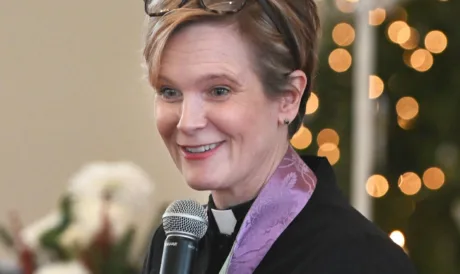
The Rev. Ellie Johns-Kelley serves as the Ministry Relations Officer for the Allegheny & Chesapeake Region of the Presbyterian Foundation. She is a minister member of the Presbytery of West Virginia and a graduate of Muskingum College and Pittsburgh Theological Seminary. She maintains an office at First Presbyterian Church on Spruce Street. She is writing as part of the Morgantown Faith Leaders Network.