
Walk and talk: Allegheny Trail hike doubles as research project
Trending
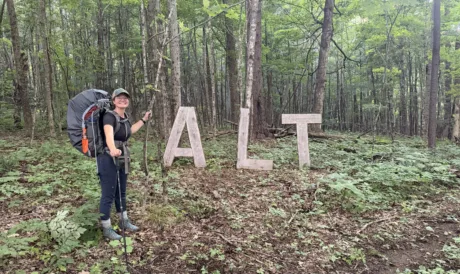
MORGANTOWN - It's 10 a.m. Friday. It's pouring rain, and West Virginia transplant Emma Crow-Willard is on her way to someplace else.
Someplace with sand, and seawater.
No offense to the hills and the trees and the Mountain State mosquitos, but when you've just spent 26 days on foot in the West Virginia countryside, a change of scenery is in order.
Drawn by natural beauty and incentivized by the Ascend West Virginia program created to attract talent to the state, Crow-Willard, a Colorado native, made her way to Morgantown two years ago.
"I was working as an editorial director, a managing producer for a multimedia company doing a lot of work around science and data and translating that into policy impact for policymakers, for investors, for business leaders and that kind of thing," she said.
A chance encounter shortly after her arrival put the Allegheny Trail on her mental map.
The longest hiking trail in West Virginia, it runs 316 miles from the Mason-Dixon Line at the Pennsylvania border to Peters Mountain in Monroe County, where it links up with the Appalachian Trail.
Crow-Willard picked up a sticker and put it on her fridge.
One day, she thought.
Inspiration struck earlier this year.
What if her personal affection for the outdoors and a desire to see more of West Virginia via the Allegheny Trail could be coupled with her professional skill in data collection and presentation?
The Allegheny Trail Economics Expedition was born.
"I went to the Outdoor Economy Summit in Charleston in February and there was so much energy and momentum. I could tell this was going to be, and is, growing as an industry in West Virginia. So I thought, yeah, this is a great thing to help support that; to gather data while I'm hiking," Crow-Willard said.
"I'm an extrovert. Like, I love people. I love talking to people. So, three weeks on the trail not talking to anyone, that's enjoyable. But I thought it's more fun to get to know the people along the way to try to understand the economy, the towns and communities, and how these towns have changed over the years ... What were they doing? What were they relying on? How have they grown and changed, or not grown? I just thought that'd be a cool thing to look into and a way also to give back to West Virginia for bringing me here."
And that's what happened – 316 miles, a dozen or so communities, hours of conversation, countless rain drops, untold bug bites, two bears and a rattlesnake.
While Crow-Willard admits she may have initially underestimated the physical challenge she'd undertaken, she said West Virginia always came through with sufficient inspiration - be it in the form of the people and stories she encountered or the spectacle and variety of the scenery.
"I remember there was a section where I was literally just walking in a stream for like a mile, and the rhododendrons were blooming. When you're surrounded by rhododendrons, it's so dark. But I came out at the end and walked up this hill into a field near Terra Alta, and I just remember the sky was so blue, and the clouds were beautiful and there were flowers in the field. The sun was setting," she said. "It was perfect."
With the hiking boots portion of the project complete, Crow-Willard will now turn her focus to compiling and presenting her findings in a number of ways.
Working through a process shared by the University of Montana, an analysis of the economic impact of the trail on local economies will be compiled.
She's also working with Generation West Virginia on the production of an online dashboard that highlights what kinds of amenities are available in the various communities as well the opportunities available for investment to provide some of those missing components.
"Pulling from publicly available information and the data that I collected, I’m putting together this economic report that I'm then taking to policy makers at the state level, and well as to local and regional leaders - town mayors, CVB directors - to provide information that can then be used to help them apply for and leverage more funding for specific needs," Crow-Willard said. "And then I'm also producing short videos about each town and how they've changed, how their economies have changed and what people are hopeful about or what they want their towns to look in the future. I'll also be creating one longer film about the whole process."