
MCHD spreads oral rabies vaccine baits around Morgantown
Trending
MORGANTOWN - Sanitarians with the Monongalia County Health Department's Environmental Health division have hand-distributed some 1,400 doses of oral rabies vaccine in and around Morgantown this week.
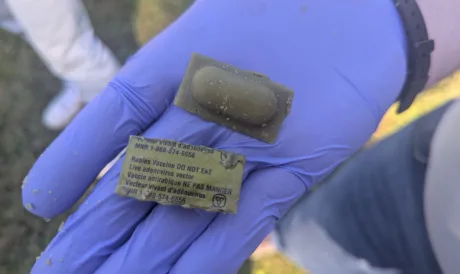
Dog walkers take note, the baits were disbursed in areas along the rail-trail, in the grassy areas around WVU's Hope Coliseum and the old Mountaineer Mall and other locations.
"The baits are safe if a dog eats them, but too much could make them throw up," MCHD Environmental Health Program Manager Jennifer Costolo-Michael said.
The baits are packaged in two-inch plastic sachets and coated with an attractant.
Anyone who encounters the baits should leave them alone unless they are in a path where children or pets could find them. In that instance, baits can be moved with a gloved hand. If touched with bare hands, wash with soap and water as soon as possible.
MCHD is the only health department in West Virginia that hand-distributes baits within their coverage area.
That work is in conjunction with the U.S. Department of Agriculture which will drop baits from fixed-wing aircraft in rural parts of Monongalia County from mid-to-late August.
According to Chelsea Hartley, rabies technician with the USDA's Animal and Plant Health Inspection Service in Elkins, baits will be dropped by helicopter along the Ohio River and in the Northern Panhandle from Aug. 13-18. Additional baits will be dropped from airplanes in other rural areas of West Virginia from Aug. 25 through Sept. 4.
According to information distributed by the USDA, the agency will drop approximately 364,000 oral rabies vaccine baits by plane or other vehicles in portions of western Pennsylvania and West Virginia.
Personnel with the USDA's Animal and Plant Health Inspection Service will begin a follow-up phase six to eight weeks after distribution to determine vaccination rates in raccoons and skunks within the baited areas.
Bait distribution takes place this time of year so that wildlife born in the spring is old enough to be eating independently.
"They are usually eaten within four days and will be gone in a week," Costolo-Michael said. "The wildlife will eat them up."
The Centers for Disease Control and Prevention lists rabies as a viral disease found only in mammals that attacks the brain and nervous system, ultimately causing death. Mammals, including people, can be infected via the saliva of a rabid animal through a bite or scratch.
In West Virginia, state code mandates all mammalian pets (dogs, cats, ferrets, etc.) must be up to date on rabies vaccines.
Individuals who interact with a potentially rabid animal, or with a pet that has interacted with one, should visit a hospital emergency department to determine if postexposure immunoglobulin treatment is necessary.
The process involving a pet that has interacted with a rabid animal varies depending on its level of vaccination.
According to the MCHD, there have been no confirmed cases of rabies so far in 2026. There were two cases in 2025.
That's a far cry from the 20 confirmed cases in 2019, which prompted the hand distribution of oral rabies vaccine in the county in addition to the efforts from the USDA.