
Resiliency vs. red tape: Director says code limits $5M flood fund
Trending
CHARLESTON - After four years, a fund created by the West Virginia Legislature to proactively address flood mitigation has money, but the state director charged with leading flood resiliency efforts told lawmakers his office needs more flexibility to use the funds.
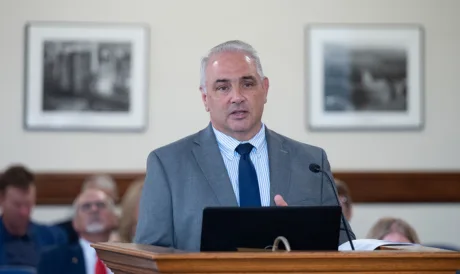
The Joint Legislative Committee on Flooding received a report Tuesday morning from Robert Martin, director of the State Resiliency Office, on the final day of legislative interim meetings at the State Capitol Building.
The committee was formed in 2017 following the devastating 2016 floods in southern and central West Virginia. At the urging of the Flood Committee, the Legislature passed Senate Bill 586 in 2020, reorganizing the former Department of Military Affairs and Public Safety into the Department of Homeland Security and creating the State Resiliency Office within the Governor’s Office.
The Resiliency Office was created to work with state agencies to ensure that areas hit with natural disasters and man-made emergencies can bounce back quickly. It also manages non-federal disaster and hazard mitigation grant funding. Lawmakers further reformed the State Resiliency Office in 2023 with SB 677, giving the office authority over the West Virginia Disaster Recovery Fund and creating the West Virginia Flood Resiliency Trust Fund within the State Resiliency and Flood Protection Act.
The Flood Resiliency fund was created to encourage local governments to work on flood protection and prevention projects and prioritize low-income geographic areas and the use of nature-based solutions - using the local environment and features to protect against flood damage. However, the Legislature has never appropriated money for the Flood Resiliency Trust Fund.
That changed during the 2026 legislative session when House Minority Leader Sean Hornbuckle, D-Cabell, offered a successful amendment to the bill setting the general revenue budget for fiscal year 2027 to appropriate $5 million for the fund from surplus tax collections available at the end of fiscal year 2026, which ended June 30. Surplus tax collections for FY26 were more than $370 million, covering all surplus appropriation requests, including for the Flood Resiliency Fund.
"It hit the account yesterday," Martin told committee members Tuesday. "Thank you all for your part, on my behalf and the State of West Virginia and the citizens, that you were able to put the excess funds into the account for this year that we’ll be able to start working with."
While the Flood Resiliency Fund is highly flexible as far as types of money it can accept - including funds from federal, private and foreign sources - its expenditures are governed by rigid statutory mandates under state code, including specific set-asides for low-income areas (50%) and nature-based solutions (50%). And 25% of nature-based funds must be used for acquisition, relocation assistance or floodplain restoration.
"Now, floodplain restoration is great," Martin said. "The problem is this ties it directly to properties that would be bought with this fund, and that’s the way it’s worded in there. So, the activities have to be if we buy out a property, then we could do floodplain restoration in that area. That really narrows our focus. I can’t use the dollars to do floodplain restoration in an area."
Martin said the Federal Emergency Management Agency has a program called "Swift Current," which expedites federal funding to buy out properties insured by the National Flood Insurance Program that either are prone to flooding or damaged beyond repair.
"What I would like to be able to do is to team these dollars with federal dollars that are already doing buyout programs," Martin said. "There is not a way that I can use this money to go ahead and do floodplain restoration where those properties are being brought out. It’ll have to happen by others because of the way that the terminology is in this code."
Martin would also like to use the Flood Resiliency Fund to assist with relocating residents out of floodplains. Martin said a relocation assistance program with incentives could help residents leave floodplains while also keeping them within their home counties or the state after buyouts, a service not typically provided by federal programs.
"Once you get outside of the federal government where they have to mandate you’re moving out of an area, the federal government does not provide relocation assistance to the people they’re buying out," Martin said.
"Ideally, we would be able to provide relocation assistance just like the federal government does under the Uniform Relocation Act, and we would be able to provide an incentive for those people to stay in the state, stay in their county, ideally, but be able to find safe, sanitary housing that is out of the floodplain and provide that to them to assist them in staying in the state, like I said, if not in the county," he continued.
Martin said a significant barrier to flood fund disbursement in state code is the requirement for municipalities or political subdivisions to meet specific eligibility criteria through the Community Rating System, a voluntary incentive program through FEMA that encourages local governments to exceed minimum floodplain management requirements set by NFIP.
If a community does not meet current CRA requirements, they must sign a memorandum of agreement pledging to reach compliance within 24 months. Failure to meet these requirements within the window may result in the community becoming ineligible for future disbursements from the Disaster Recovery Trust Fund.
"If we get into the Community Rating System currently in the State of West Virginia right now, there are only nine counties that are participants and five communities," Martin said. "Again, that takes away our flexibility to work with communities and create more resiliency within the communities themselves."
The State Resiliency Office is working on partnerships to help obtain additional grants for flood resiliency and mitigation projects. A project with Marshall University would develop a Resiliency Center and Hub at the school to serve as a model for community mobilization and debris cleanup. A partnership with WVU Tech and Virginia Tech would create off-site prefabricated homes for displaced residents coupled with financing.
The office is also working on obtaining FEMA Building Resilient Infrastructure and Communities grants to help provide engineers and planners to all 55 counties to help them design flood mitigation programs, as well as a pilot program for the Sentry flood detection and early warning system.
Steven Allen Adams can be reached at sadams@newsandsentinel.com.