
The rest of the story: Kabourek on moving past controversy to lead WVU’s strategic reinvention
Trending
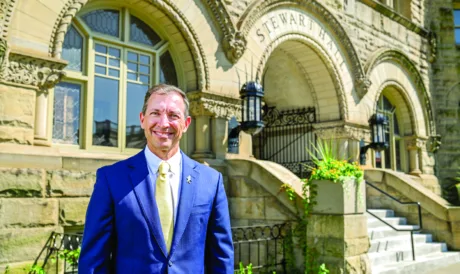
MORGANTOWN - Chris Kabourek, new chief financial officer for West Virginia University, understands he brings with him baggage from his previous role at The Ohio State University.
But 60 days into his tenure, Kabourek said he is ready to look forward and not backward.
WVU President Michael Benson announced in April that Kabourek would join his administration as CFO effective June 1. Kabourek has nearly 30 years of experience in higher education finance and administration, including serving as interim president and senior vice president and chief financial officer at the University of Nebraska System, and senior vice president for administration and planning at Ohio State.
Benson’s announcement came four days after Kabourek resigned from Ohio State. On April 20, OSU released findings from an internal investigation of former OSU President Walter "Ted" Carter Jr. According to that report’s findings, Carter was allegedly engaged in a relationship with Krisanthe Vlachos, traveling with her on trips and helping her obtain employment and resources for a podcast she hosted.
The university report details how Carter pressured staff and external partners to provide professional opportunities, funding and technical support for Vlachos's failing business ventures, although university systems successfully blocked the misuse of public funds.
The report alleges that Kabourek, who worked with Carter when he was at the University of Nebraska, was involved in facilitating these favors for Vlacho and failed to report the misconduct or ethical lapses to the proper authorities. The report went on to label Kabourek's excuses for his involvement as "not credible."
During a recent interview, Kabourek said he was limited in what he could say about the report but disputed its findings, citing mischaracterizations and a lack of opportunity to refute it.
"Let’s say there’s two sides to every story, and at some point, we look forward to telling our side of the story," he said. "Overall, I’m disappointed in the tone and tenure. ... If you look at my 30-year history over public higher education, I’ve always served with integrity. And so, at the appropriate time, the rest of the story will come out. My focus really is on West Virginia University and the people of West Virginia and serving them."
Kabourek recognizes he started work at WVU under a cloud of intrigue, but he believes he can overcome any doubts about his experience and ethics and be of service to WVU.
"I recognize trust is earned, so it will take some time. But you don’t serve in 30 years of public higher education in leadership roles without having trust," he said.
Kabourek, a first-generation college student, said his experiences leading his alma mater at Nebraska have prepared him for working at WVU.
"Coming from a small state in Nebraska, I see a lot of similarities to the challenges," he said. "I wanted to be at West Virginia. I think based on my experience, I can bring a lot of added value and maybe some solutions to some of the issues I’ve been working on. I’m just really excited. We’re grateful to be here. And again, I’m going to focus on the future and not so much on the past."
Kabourek characterizes WVU as "stabilized" following the recent Academic Transformation that saw previous university officials eliminate several programs and cut more than 300 positions to address a $45 million structural deficit. Kabourek said he intends to shift the focus at WVU from financial recovery to strategic investment. The WVU Board of Governors approved a $1.3 billion budget for fiscal year 2027.
"We are stabilized. We are going to invest. And we started to make some small steps into that in the budget the board approved a couple months ago," Kabourek said. "We’re going to invest in the quality of the education here ... in our students, and most importantly, our faculty and staff, which are really the heartbeat of this institution in terms of compensation and being competitive in that space. But we have a lot of work to do."
Part of strategic planning involves planning for the enrollment cliff, when colleges and universities across the country deal with a smaller pool of high school graduates due to declining birthrates. Kabourek said it will be important for WVU to offer degree programs that are in demand but also deal with new realities, such as artificial intelligence.
"It’s no different than being in business and trying to predict what your customers are going to need," he said. "I think everybody is trying to get our arms around this new world of artificial intelligence and how that’s going to impact everything. So, from that aspect, I don’t think this is any different than the challenge that small business, West Virginia, state government, we’re all facing."
Kabourek wants to work on affordability issues for first-generation college students, such as last-dollar-in programs that help students pay for college after all other sources - such as scholarships, grants and loans - are exhausted.
"If you want to come to West Virginia University, we’re going to do everything we can in our power to help you from an affordability aspect," he said. "Absolutely, I’m a big supporter of first-generation college student affordability. Access will always be part of my ethos. And unfortunately, I think there’s some institutions across the country that have lost some sight of that fact."
Kabourek has also identified specific operational needs for the WVU campus. WVU has launched a request for proposal to find a partner for a comprehensive master planning exercise to make improvements to the campus footprint over the next 25 to 50 years. That review will include a look at infrastructure, such as sewer lines, sidewalks and weatherization of university-owned buildings and dorms.
"While how the campus looks is important, it’s just equally important to make sure our infrastructure is up to date," Kabourek said. "It’s not as fun to replace sewer lines and sidewalks and windows, but that’s just as important to the campus experience. We want to make sure students have spaces that are warm, safe, dry, and our faculty and staff have those as well."
Despite the issues from his previous tenure at OSU, Kabourek said he is ready to move forward to help execute the vision of WVU President Benson and serve the students, faculty and staff, and alumni of West Virginia University.
"We’ll make sure every dollar counts because ... it’s our duty to make sure West Virginians understand that we’re going to provide tremendous value to them, a great degree, a great experience," Kabourek said. "Our financial foundation is (in) a good place and we’re ready to invest. We’re ready to grow. ... We want all of West Virginia, not just our students and our alumni, to be proud of this place. And I think we’ve got some really great momentum, and the future is nothing but bright for this."