
Dr. Zafar Nomani: Nourishment for the soul (and the importance of saying ‘thank you’)
Trending
MORGANTOWN - Sometimes, you just have to go to a certain fast-food restaurant specializing in fish and chips (of the decidedly non-Brit variety).
And sometimes, at that certain fast-food restaurant specializing in fish and chips of the decidedly non-Brit variety ... you just have to go full-on rock 'n' roll, at the counter.
You know: With fish, fries, chicken strips, hushpuppies and the giant, ice-laden soda from the fountain.
Don't forget the sliver of pie.
Sometimes, yes - you have to do this.
Even if you are Zafar Nomani, the West Virginia University nutritionist renowned the world over for your research in the field.
"I know, isn't that funny?" his daughter, Asra Nomani said. "But that was Dad. He loved his life. He loved his experiences. He was full of gratitude because he was still here."
"Gratitude" was the watchword for Dr. Nomani, 93, who died Wednesday at J.W. Ruby Hospital in Morgantown after a period of declining health.
The circumstance granting the weight of that gratitude couldn’t have been more serious.
He was a little boy with a growling belly in India in 1943, when the Bengal famine settled over his country like a mourning shroud.
Ruthless rationing and collapsing markets wrought by World War II did his country worse than Hitler's tanks ever could.
A devastating cyclone that hit at the same time and swamped giant swaths of farmland and the region's chief rice crop, sealed it.
More than 3 million - roughly twice the population of West Virginia - would starve to death.
Relief, though, did arrive.
Young Zafar stood in the rationing lines until his knees wobbled and he felt woozy.
The sorghum grain product hurt his throat and made his eyes well, but it was sustenance.
It filled his belly, his daughter said, while fortifying him with the gratitude that would shape the rest of his days.
"So he's a little boy," Asra said, "and he has this defining moment: He doesn't want to be hungry again and he doesn't want anyone else to be hungry again."
TAKE ME HOME
He was a dutiful student. He began the study of nutrition in earnest at the university level. An opportunity across an ocean beckoned at Rutgers in New Jersey.
Off, the family went: Zafar, his partner and spouse, Sajida, and their two young children, Asra and Mustafa, who were both born in Bombay. Sajida, the matriarch, babysat for $1 a day to raise money for the TWA plane tickets.
Dr. Nomani, who was building his reputation in the lab and in the field, didn't say no when WVU called.
The way Asra remembers it, the gas tank was hovering near empty when the family motored into the Mountain State - but "Country Roads" was on the radio and a smile was on Dr. Nomani's face.
"I seriously think we coasted into Morgantown," she said.
"We had this international lineage, but Mustafa and I were New Jersey kids at that point, moving to West Virginia, so we knew that was gonna be interesting. Of course, we ended up loving it here."
Mustafa would come to be known as the "Pele of Morgantown," for his prowess on the soccer field.
And Asra was a journalism whiz-kid who started out with an internship at The Dominion Post and landed a job as a reporter with The Wall Street Journal at the age of 23.
For a little family that had logged several big journeys, it was the Morgantown version of the American dream.
Sajida Nomani, who survives her husband, became a businesswoman active in University City concerns and global, social justice concerns - while he did the most critical, clinical work of his career.
Occasional fast-food forays aside, Dr. Nomani mainly worked at putting out sound nutritional principles in a state not necessarily known for healthy food choices.
Food deserts.
Food insecurity.
Said choices which he knew were driven by the generational poverty that always made him harken back to his own boyhood during the Bengal famine.
His studies, too, on the healthful importance of proper fasting during Ramadan were lauded both in medical and faith circles.
DAD, IN THE HOUSE (AND THE MOMENT)
Dr. Nomani thrived as he grew older, gleefully billing himself as "The Super Ager" in his social media accounts.
Mustafa remembers the super-presence of his dad at school events and sporting events.
"He was never not there," Mustafa said. "He was never not cheering for me and supporting me. We would do road trips. Me and him."
Asara, who works with words for a living, was always awed by her dad's semantics, as related to the above.
"A lot of times you'll hear people say, 'Well, I have to pick up my kid at soccer practice or the dance studio,' or 'I have to do this, or 'I have to do that,'" she said.
"With my father, it was never 'I have to do this' - it was always, 'I get to do this.' And that's a big difference. He always felt so appreciative about how his life turned out."
"You can learn," was another mantra now staying with his grandsons, Samir and Shibli, who are both based in northern Virginia.
Samir is a newspaper reporter, and Shibli is a software engineer.
And their grandpa was the DIY king, they said.
"If he didn't know how to do something, he'd read a book and teach himself," Samir said.
"He did renovations in his house," Shibli seconded. "I've got my own place now, and he started me thinking I should start learning how to fix some things, too. I don't think there was anything he couldn't do."
WITH APPRECIATION
He excelled at simply being nice to people, his granddaughter Safiyyah said.
She's a neurology nurse practitioner at WVU Medicine and got to look in on Dr. Nomani daily.
It didn't take long for her grandfather to become the favorite patient of everyone who worked the ward and Room 8, his room.
When he was able, he'd sketch molecular charts and cholesterol tables for the benefit of the residents making their daily rounds, she said.
And even when he wasn't able (sometimes he could only mouth the words) he'd still say "Thank you" - to the nurses, techs, the custodial staff, respiratory therapists who tended to him.
"He was about being humble and respecting others," she said. "That's his lasting lesson for me."
Funeral rites were Friday at the Jummah Islamic Center and Dr. Nomani's burial followed in a cemetery on Fairchance Road.
A more secular celebration was set for Saturday. Those wishing to attend may text or call 304-685-2189 for more information, the family said.
'AND HAVE FUN ...'
For Asra, cellphones and the like were also about chronicling her dad's life and times via the video clips she'd capture.
On one, he was using a power saw - he was 87 at the time - to take care of a large, unwieldy branch on a tree in her yard that needed pruning.
All the while talking about biochemistry, sociology and the science of invariance in the natural world.
In another - on his 91st birthday, in fact - he was warbling along (and charmingly off-key) to "Forever and Ever, Amen," the Nashville singalong about relationships and lasting love.
The renaissance researcher tossed in an inspired adlib, which served as the coda.
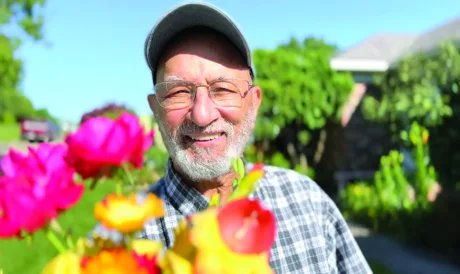
"And have fun," he said, showing off a bouquet of flowers from his garden. "It's the beauty of life."