
Leo Horacek dies at 107: WVU professor emeritus taught nearly 60 years in Morgantown
Trending
MORGANTOWN - Ruffy perked up when Leo Horacek sidled over to the piano at his house on Willowdale Road that one afternoon back in 2022.
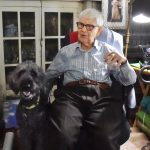
His canine roommate - a poodle, without the fancy haircut - knew what was coming.
Horacek, a professor emeritus of music at West Virginia University who had just turned 103 that year, leaned into one of his favorite tunes by one of his favorite musicians.
It was "Caravan," the Latin-tinged mover made famous by Duke Ellington in 1936, when Horacek was a young man back in Kansas.
Back before he shipped out to World War II and the experience that would define the rest of his days.
"Caravan" was in his regular rotation. He played it daily to keep his fingers limber. He scored the horn charts just as Ellington did, to do the same for his musician's brain.
His left hand locked on with the driving bass line while his right danced up and down - just like the dapples of sunlight he would see glinting off the Pacific Ocean from his vantage as a fighter pilot.
Ruffy’s tail made like a metronome as he lolled at the professor's feet while he played.
"Well, I don't think I made too many mistakes this time," Horacek said, with a self-deprecating chuckle as the final notes settled. "Huh, Ruffy?"
The professor was 107 when he died last week in Moundsville. He'd made his home there with his son and daughter-in-law in recent months.
Yes, there's a piano in the living room and yes, he was still coaxing "Caravan" out of it, he told The Dominion Post last year on the occasion of his 106th.
"Well, it is what I do," he said.
Music, he meant. He loved the piano and trumpet was his main instrument - but neither were necessarily his voice, however.
Being in front of a classroom or rehearsal space was.
He didn't care if you were a kindergartener scratching out "Twinkle, Twinkle, Little Star" on a pint-sized violin - or a community orchestra battening it down for Beethoven's Fifth.
Either way, with gentle coaching and good humor, he was going to help you achieve the full technical and emotional levels of your performance, no matter your proficiency.
"I'm not sure if I was all that talented as a performer but I really enjoyed the teaching aspects of music," said the professor who moved his family to Morgantown after joining the fine arts faculty at WVU in 1960.
He was just 41 then, but he'd already had a symphony of life experience.
Being shot down twice in World War II has a way of doing that.
SONGS OF THE GREATEST GENERATION
Horacek already knew how to fly planes when he mustered into the military as the war raged across Europe and the South Pacific.
The pilot from the Heartland who logged several combat missions was once forced to ditch his Hellcat in the water - still within gunsight range of the batteries that brought him down.
An American submarine plucked him to safety.
"Our generation was just doing what we were called to do," said the once-and-future music educator, who wore the bars of a lieutenant at war's end. "It was our job."
Like a lot of returning vets armed with the G.I. Bill, he was a young man in a hurry when he landed in music classrooms at the University of Kansas, to exchange his mission-briefing books for textbooks.
Horacek earned his doctorate in trumpet studies there in 1955, while teaching in elementary classrooms and small colleges in his home state along his eventual flight path to Morgantown.
DANCING IN THE MOMENT
Prior to his move to the Northern Panhandle, that white-framed house on Willowdale was where he would stay and make a life, personally and professionally.
Along with WVU, he was the inaugural music director of St. Thomas a Becket, when the Episcopalian church was founded in Morgantown in 1979. Services will be held there in his honor at 3 p.m. Sunday.
He retired from the university in 1982, but he literally didn't miss one beat.
Horacek gave private lessons in trumpet, before turning to WVU's Osher Lifelong Learning Institute, where he taught seminar-styled courses on everything from Bach to bebop.
Participants gave him a standing ovation in 2019 following the conclusion of his final course for the institute. He decided to step away after his 100th birthday.
CODA
As the years stacked, he worked hard to keep the melancholy out of his soundtrack.
It wasn't always easy, he said.
Not when you outlive your first wife, your second wife and two of your sons.
Still, there were all those former students and colleagues who kept in contact.
There was Duke Ellington and "Caravan" and those trumpet lines he would score meticulously on staff paper, because - as said - music was what he did.
Ruffy kept things lively. If the tennis ball proved elusive behind the couch, there was the pup's squeaky toy backup - "That's really his favorite song," Horacek said.
"I don't necessarily recommend being 106," the professor mused.
"But, I'm not in any pain and I'm grateful for my years. Thank you for your birthday wishes. I'll talk to you another time."