
Something in the air: Smoke from Canada’s wildfires prompt atmosphere of caution
Trending
MORGANTOWN - Where there's fire, there's smoke.
Massive plumes of it, generated by more than 800 wildfires currently raging across Canada.
The incendiary byproduct has caused a lot of America's northeast, of late, to resemble a dystopian sunset in the middle of the day.
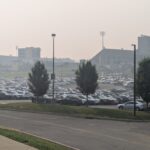
A slightly acrid gauze over north-central West Virginia was more like it Friday.
The local atmosphere prompted both an air-quality alert from the National Weather Service and a cautionary call from Dr. Brian Huggins, the chief officer of the Monongalia County Health Department.
As of 2 p.m. Friday, Morgantown was registering a 259 on the U.S. Air Quality Index, which charts the measure of the particulate quality of the air we breathe. So was Kingwood.
Fairmont and Clarksburg to the south each came in readings of 236 on the index which is color-coded.
Green is "Good" on the index, which may be accessed at https://www.airnow.gov/.
Purple, the range that is currently taking in the above-mentioned towns, is considered "Very Unhealthy," in the hierarchy of the index. It falls right before Maroon and its "Hazardous" designation.
Huggins on Friday was urging some purple-prudence for sake of one's lungs.
The administrator called on public pools to close for the day and organizations conducting youth camps to move activities indoors.
If you're a contractor booked with roofing jobs, Huggins also wanted you to reconsider sending your crews out, given the day's conditions.
Children, older adults, pregnant women, and adults with respiratory or heart disease should avoid outdoor physical activity altogether until the smoke clears, he added.
Wearing a fitted and N95 or KN95 respirator mask couldn't hurt either.
Just breathe in some common sense, Huggins said.
People who are serious joggers or runners, for example, he said.
"Don't run," he said. At least outdoors.
"As soon as you start to put stress on your lungs, with that breathing, you can actually cause a little micro-damage in your lungs - and then with the particles, that can cause even bigger problems."
Forget about how cozy and benign it all looks on the campground or fireplace at Christmas, Tim Nurkowicz said.
He directs West Virginia University's Center for Inhalation Toxicology.
Trees on fire, Nurkowicz said, are always going to generate elements unhealthy for the inhaling, such as benzene and formaldehyde, which are part of the high-Fahrenheit proceedings.
Canada's fires are also consuming neighborhoods, he said.
And when you add all those houses, with all their carpeting, plastics and synthetics - you've got a perfect recipe for long-term lung damage.
"Each house going up is a toxic disaster unto itself," he said.
Meanwhile, AccuWeather is calling for a strong chance of a "drenching" thunderstorm today, but where there's rain, Nurkiewicz said - there's still smoke.
Smoke that will literally hang around a while.
A long while.
Thank the jet stream, he said, those narrow, fast-moving air currents at the edge of Earth's atmosphere.
"There are still particles from Pompeii up there," he said, referring to the ancient Roman city destroyed by the volcanic eruption of Mount Vesuvius - in 79 A.D.