
‘Mona the Monkey’ is a tale of primate predicaments, medical breakthroughs and community possibilities
Trending
CAYO SANTIAGO, Puerto Rico - It wasn't something out of Walt Disney.
The primate inhabitants of Cayo Santiago didn't greet Matthew Kessler with pupil-wide charm and cute, anthropomorphic antics when he landed there in the 1970s.
In fact, they tended to be aggressive - snippy, at least - if he even thought about getting close.
However, for a doctor of veterinary medicine, the nearly 2,000 Rhesus macaque monkeys that reside on the tiny island off the coast of Puerto Rico yielded something far more lasting which couldn't have been more friendly, in a clinical way.
Research.
And, research possibilities.
That's because more than 90% of their DNA is the same as humans.
They can be susceptible to arthritis and Alzheimer's, same as humans, and have been known to carry and come down with tuberculosis - same as humans.
Same as humans, vaccines can hit them with pesky side effects and other outcomes that could be better.
Males among Cayo Santiago's chief population tend to be mama's boys (Rhesus monkey colonies are on the matriarchal side) but the lads still hang out a lot with their buddies and will even render aid, if one gets in a predicament.
Provided, just like humans, that two guy monkeys don't have, say, the same romantic devices on a girl monkey.
Yep, Kessler asserts.
Same as humans.
He stood there, blinking in the Caribbean sun, and smiled.
"My first thought was, 'Well, I'm home.'"
MEET MONA
The island and Cayo Santiago research confines were home to Kessler for 20 years, where he would serve as director of the Caribbean Primate Research Center, housed at the University of Puerto Rico.
Recently, he did collaborate, though, on a Disney-style take on life among the Rhesus monkeys there.
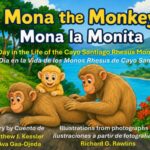
With help from his research colleague and photographer friend Richard Rawlins, Kessler and his wife, Ava Gaa Ojeda, wrote and created "Mona the Monkey: A Day in the Life of the Cayo Santiago Rhesus Monkeys."
The trio recently published it on Amazon. For ordering particulars, go to the site and type "Mona the Monkey" in the search field.
Ojeda is a former field biologist with the Puerto Rico Department of Natural Resources. Rawlins served for years as scientist-in-charge of the Cayo Santiago colony.
Geared to young readers, the book alternates in English and Spanish as it tells the story of Mona and her life and times on the island with her immediate family in the colony. Mona is a rare "golden" rhesus monkey.
Kessler and Ojeda, who now reside in retirement in the Morgantown colony, weave in a history of Cayo Santiago and of how Mona's ancestors first arrived there in 1938 after a 14,000-mile sail by sea from India on a freighter.
The book is generously illustrated with Rawlins' photographs, and all that visual work, Kessler said, was given the ChatGPT take - which rendered them "softer" and more accessible for a work for children, Kessler said.
"Richard's photographs are pretty amazing," Kessler said, "and this just makes it more relatable to the kids."
"We wanted to get impressionable brains thinking about science and language," the co-author continued. "We're debuting the book next week in elementary schools in San Juan. That should be interesting."
Meanwhile, the impressionable kids in Kessler and Ojeda's colony, their sons David and Ben, badgered their dad for years to come up with a book.
It took the Old Man a while, he said, laughing, since both boys are now grown and graduates of West Virginia University.
DON'T GET HIM STARTED ON THE PIGEONS
There just may be a Mona sequel in the works now. The trio of authors these days have started talking about the events of September 2017 when Hurricane Maria slammed Puerto Rico and Cayo Santiago.
Everyone feared the worst for the colony - but most of Mona's real-life relatives weathered the meteorological onslaught.
Other story ideas are also percolating.
"I guess we started something," Kessler said.
Back home in White Plains, N.Y., Kessler's mother started something, when her young son was clamoring for a job at the local veterinarian's office in town.
"She said, 'Take Tiny down for a checkup and see if you can get a job cleaning out cages or something,'" he remembered.
Tiny, a Dachshund, was great with the Kessler family.
But the rest of the world for the wiener dog?
Forget it.
She bit the vet - and her master didn't get an offer for employment.
Kessler, though, was advanced an opportunity to work with primates at the Harvard School of Community Health on his way to earning his Doctor of Veterinary Medicine degree from Cornell.
He parlayed that experience into an assignment allowing him to study chimpanzees at the Naval Aerospace Medical Research Laboratory in Pensacola, Fla., during his hitch in the U.S. Air Force.
Lots of experiences awaited the captain in the Air Force Veterinary Corps, including a ride on the vaunted "Vomit Comet" plane, where he observed pigeons (and himself) floating lighter-than-air with each parabola.
Air sickness is common and Kessler helped the plane live up to its rueful christening.
While he was losing his lunch, his feathered companions were jettisoning an entirely different, organic payload.
"Yeah,” he deadpanned. “Pigeon poop, weightless, is interesting."
RHESUS RESUME`
Kessler was a prolific researcher at Cayo Santiago.
There, he authored or co-authored some 135 publications, edited three volumes on Rhesus monkeys and served as a principal investigator on several grants through the National Institutes of Health.
He founded his own veterinary practice on the island, along with an environmental plastics company. Kessler was also a pioneering computer software writer, creating programs for other vet clinics in San Juan.
Academia and veterinary science brought him and his family back to the mainland. There were appointments at the University of Virginia, the Medical College of Virginia and Harvard Medical School, where he chaired the Division of Veterinary Resources.
WVU's Office for Laboratory Animal Resources recruited him in 2013. He and Ojeda, as said, have chosen to make Morgantown home.
A mutual friend invited them both to a party back in Puerto Rico - but said friend wasn’t setting up a date.
Kessler called it a courtship by way of Bausch & Lomb.
He spied Ojedo from across the way, and she was looking in his general direction as well.
And she was blinking. Rapidly.
Kessler, who knew about courtship rituals in the Rhesus colony, wondered about that.
Hmm, he thought. She's batting her eyelashes at me.
"As it turns out, she just got contacts and she kept blinking because she was trying to get used to them. But she talked to me anyway, and she went out with me anyway, and here we are."